
The Baltic States’ regaining independence from Soviet occupation was remarkable for its largely non-violent character. Enabled by the political reforms of perestroika and glasnost, it began as a form of cultural resistance with symbolic actions becoming tools of political change. In Latvia, one of the most notable visual symbols for this process was the Soviet banned national flag, which gradually transformed from a forbidden emblem of identity into an open act of resistance. In the Baltic States during the late 1980s, subtle gestures that communicated dissent without immediately provoking repression became central to the movement known as the Singing Revolution (1987–1991). Early activities rarely involved demands for full independence. Instead, environmental campaigns, commemorations of the victims of Stalinist deportations, and a revival of cultural traditions took place. These actions hinted at a deeper problem – the legitimacy of Soviet rule itself. Symbols played a crucial role in this non-violent resistance process. Among the most powerful were the emblems of the interwar Latvian state, especially the carmine red and white flag, banned after the Soviet occupation of 1940.
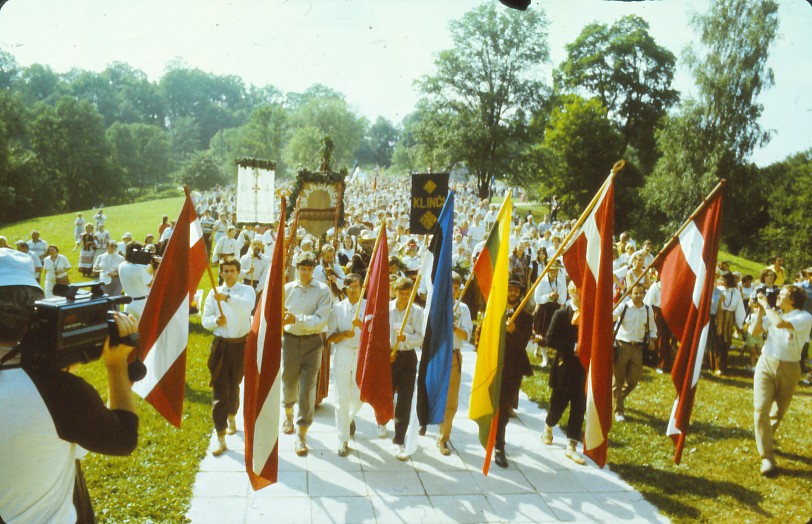
Figure 1. The flags of the Baltic states at the International Folklore Festival Baltica ’88. July 14, 1988, Turaida, Latvia. Archives of Latvian Folklore, Collection of Vaira Strautniece, LFK 2184, 1903p. Photo by Vaira Strautniece.
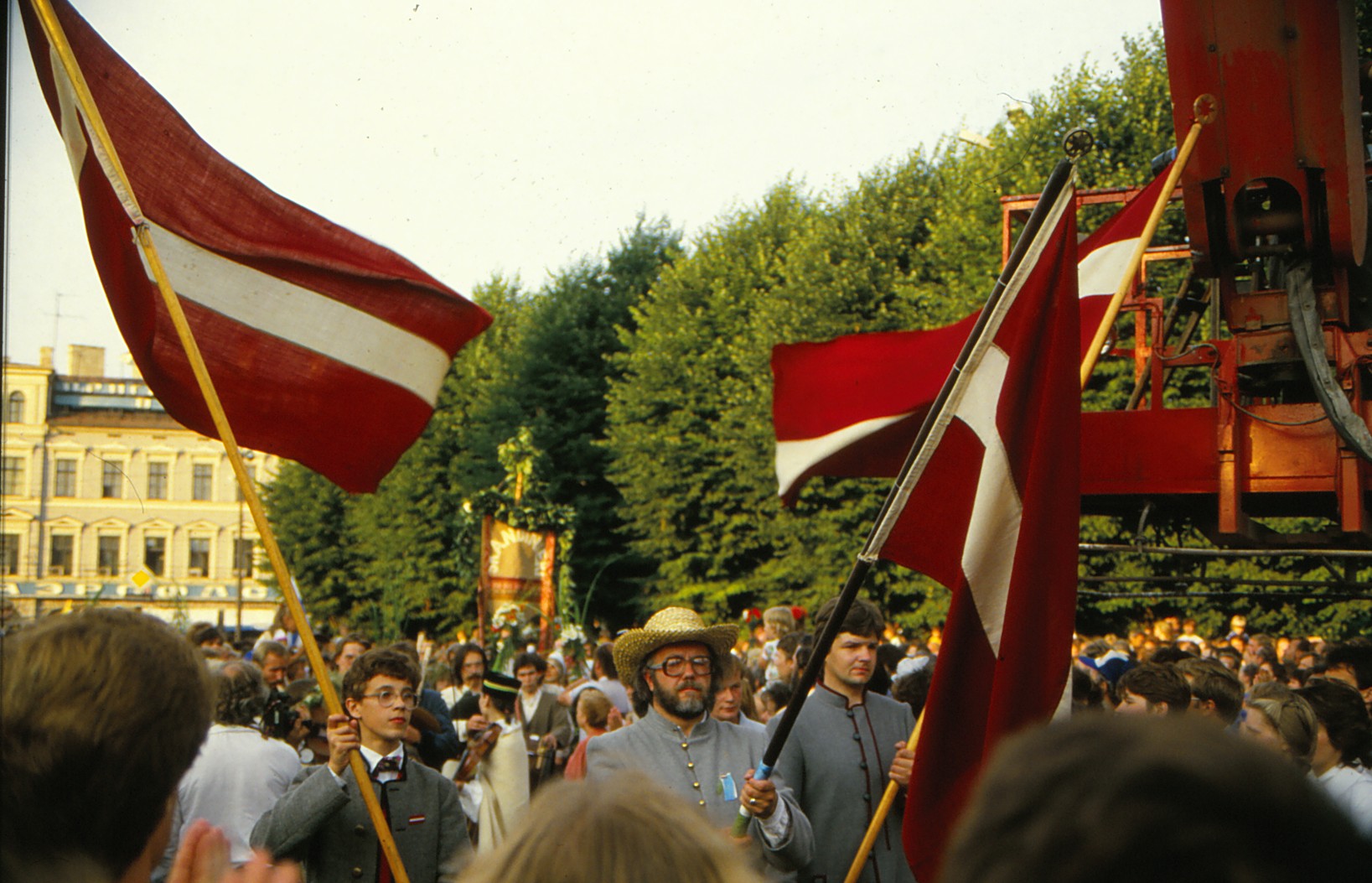
Figure 2. Dainis Stalts (center) from folklore group Skandinieki at the International Folklore Festival Baltica ’88 procession in Riga on 13 July 1988. Photo from the Alfrēds Stinkuls Collection, Archives of Latvian Folklore, LFK 2264, 364.
Historical Roots of the Flag
The carmine and white color scheme had long been associated with Latvian identity. References to these colors appear already in the 13th-century Livonian Rhymed Chronicle, and by the late 19th century, these colours had become a symbol of the Latvian national awakening. When Latvia declared independence in 1918, the carmine-white-carmine flag became the new state’s official emblem. But when the Soviet Union occupied Latvia in 1940, the flag was banned, and displaying it could lead to arrest, imprisonment, or deportation. Yet many Latvians, especially among youth groups, continued to use it both secretly and publicly as an act of protest, as a reminder of the lost independence. One of the most dramatic examples of this occurred in 1963 when a young student, Bruno Javoišs (1941–2025), climbed a 76-meter radio tower in Riga and raised the banned flag in protest against Soviet rule. He was arrested immediately and sentenced to seven years’ imprisonment in Mordovia.
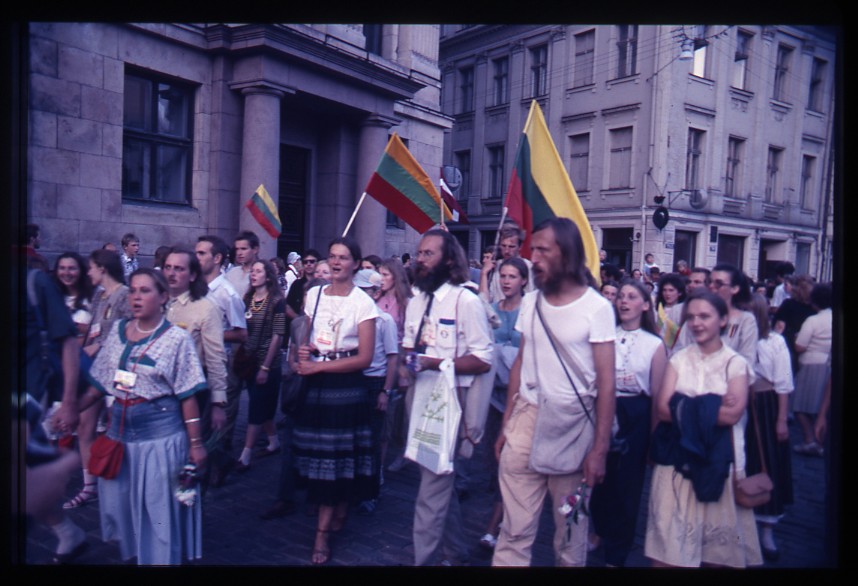
Figure 3. Participants from Lithuania with flags at the International Folklore Festival Baltica ’88 procession in Riga on 13 July 1988. Photo from the Alfrēds Stinkuls Collection, Archives of Latvian Folklore, LFK 2264, 366.
The Return of the Flag
By the late 1980s, public displays of the flag began to appear, though still technically illegal and risky. Later on, with the loosening of the Soviet regime during the Singing Revolution, the flags of the Baltic countries were reinstated even before full independence was achieved. Consequently, some of the first occasions during the Singing Revolution on which the flags were publicly displayed have gained special significance in the collective memory of the Baltic States. The first recorded proper public display of the banned Latvian flag took place on April 19, 1988, at the funeral of political dissident Gunārs Astra (1931–1988). Gunārs Astra was one of the most prominent members of Latvia’s national resistance movement, who in total spent nearly 20 years in Soviet imprisonment. At his funeral, thousands of mourners saw his coffin draped in the banned flag and lined up to pay respect by filling his grave with handfuls of sand. Two months later, on June 14, 1988, political activist and a member of the human rights defense group Helsinki 86, Konstantīns Pupurs (1964–2017), carried the banned flag through Riga during a demonstration commemorating victims of Stalinist repression. Afterwards, Soviet authorities forced him to leave the Latvian Soviet Socialist Republic. The third of these most memorable moments occurred on July 13, 1988, at the opening concert of the International Folklore Festival Baltica ’88 in Riga. The festival, which is organized and held in one of the three Baltic states each year, first took place in 1987 in Vilnius, and continues to this day. The second edition of the festival, Baltica ’88, was also one of the defining points of Latvia’s folk revival movement.
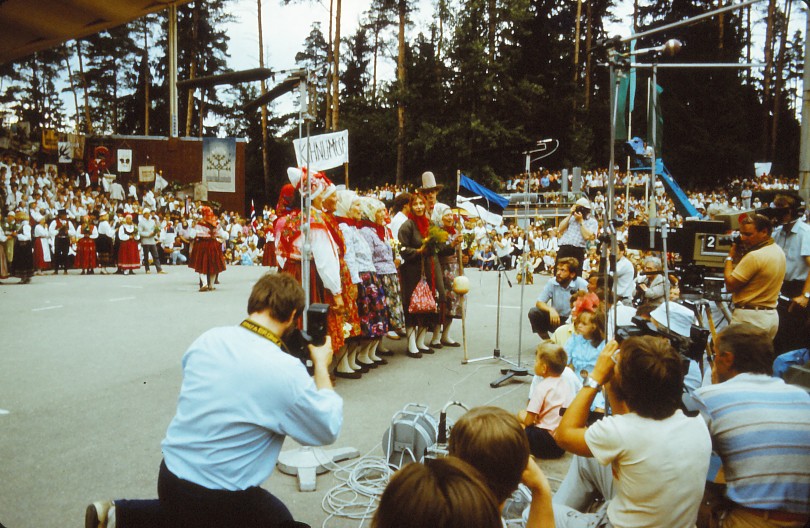
Figure 4. Participants from Estonia at the International Folklore Festival Baltica ’88 closing concert in Ogre, Latvia. July 17, 1988. Archives of Latvian Folklore, Collection of Vaira Strautniece, LFK 2184, 1874p. Photo by Vaira Strautniece.
Baltica ’88: A Cultural Festival Turns Political
The folk revival movement marks the increased interest in folklore and traditional culture in large parts of Latvian society from the late 1970s to the 1990s. The mushrooming of folklore groups was at the core of the process, but it was interwoven with folk art, crafts, and an interest in history and regional studies. Aimed against the stylized folklore performances promoted by the Soviet cultural policy, the folk revival movement became a powerful expression of countercultural creativity and an alternative lifestyle. The International Folklore Festival Baltica was one of the events that united folk revival movements in all three Baltic states, and the one in 1988 was of particular importance due to clear anti-Soviet statements. Until then, the movement had often been seen as a kind of cultural refuge, an alternative lifestyle that celebrated heritage but avoided overt politics. That changed dramatically at the opening concert of Baltica ’88. When performers appeared with the banned carmine-white-carmine flags – contrary to some later accounts, there was not just one flag and not just one person carrying it; many folklore groups brought their own flags – the audience was electrified. For the participants, it became one of the most unforgettable moments of the festival. Some Soviet officials reportedly left the hall in protest. The following festival procession through Riga and past the Freedom Monument allowed thousands more to see the flags openly displayed. What had once been a secret act of resistance was now a public statement.
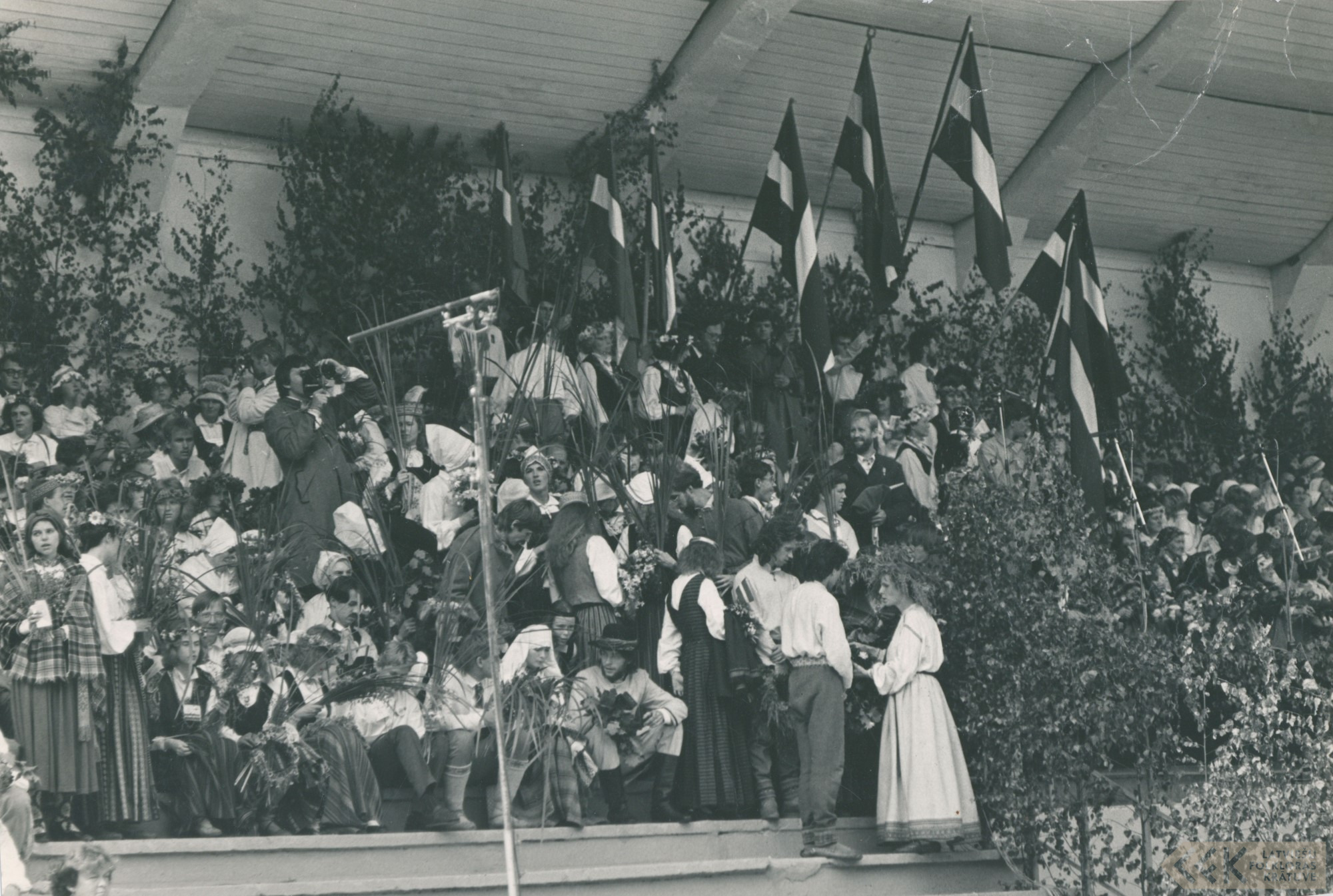
Figure 5. Closing Concert of the International Folklore Festival Baltica ’88 in Ogre, Latvia. July 17, 1988. Archives of Latvian Folklore, Collection of Ilga Reizniece, LFK 2248, 29.
Symbolic Defiance in the Baltics
Similar scenes had been unfolding across the Baltic region. In Estonia, the first public display of the banned blue-black-white flag had taken place on April 17, 1988, during a procession by the Heritage Protection Society in Tartu, and on May 14, 1988, at the Tartu Music Days. For Lithuania, it was at a commemoration of the June 14 deportations in 1988 and July 1–3, 1988, when all three Baltic flags were displayed during the Baltic students’ choral festival Gaudeamus in Vilnius. In these moments, the flags served a particular task. They helped people recognize themselves as a collective movement, which was a key ingredient in non-violent resistance. The events of the Gaudeamus festival are described in detail by Guntis Šmidchens in his masterfully written book The Power of Song. Nonviolent National Culture in the Baltic Singing Revolution:
Soviet officials rushed to confiscate the flags, which at that moment were still illegal in Lithuania, but they were not able to push through the choir of seven thousand singers, clustered together tightly, singing, and so those who had revealed the festival’s true colors remained unpunished. Baltic flags then emerged at every festival event, unmindful of the scores of policemen who looked on. Choirs in the festival procession carried at least four Lithuanian, seven Latvian, and many more Estonian flags, with all singers carrying lapel ribbons of their national colors. From this moment on, public singing events in Lithuania would always include the flags that marked them as being non-Soviet.” (Šmidchens 2014: 160)
Events like these were characteristic of the Singing Revolution, reflecting a form of non-violent resistance expressed through symbolic and mass civic actions such as flower-laying ceremonies, demonstrations, meetings, large petition campaigns, displays of national symbols, and major protests like the Baltic Way.
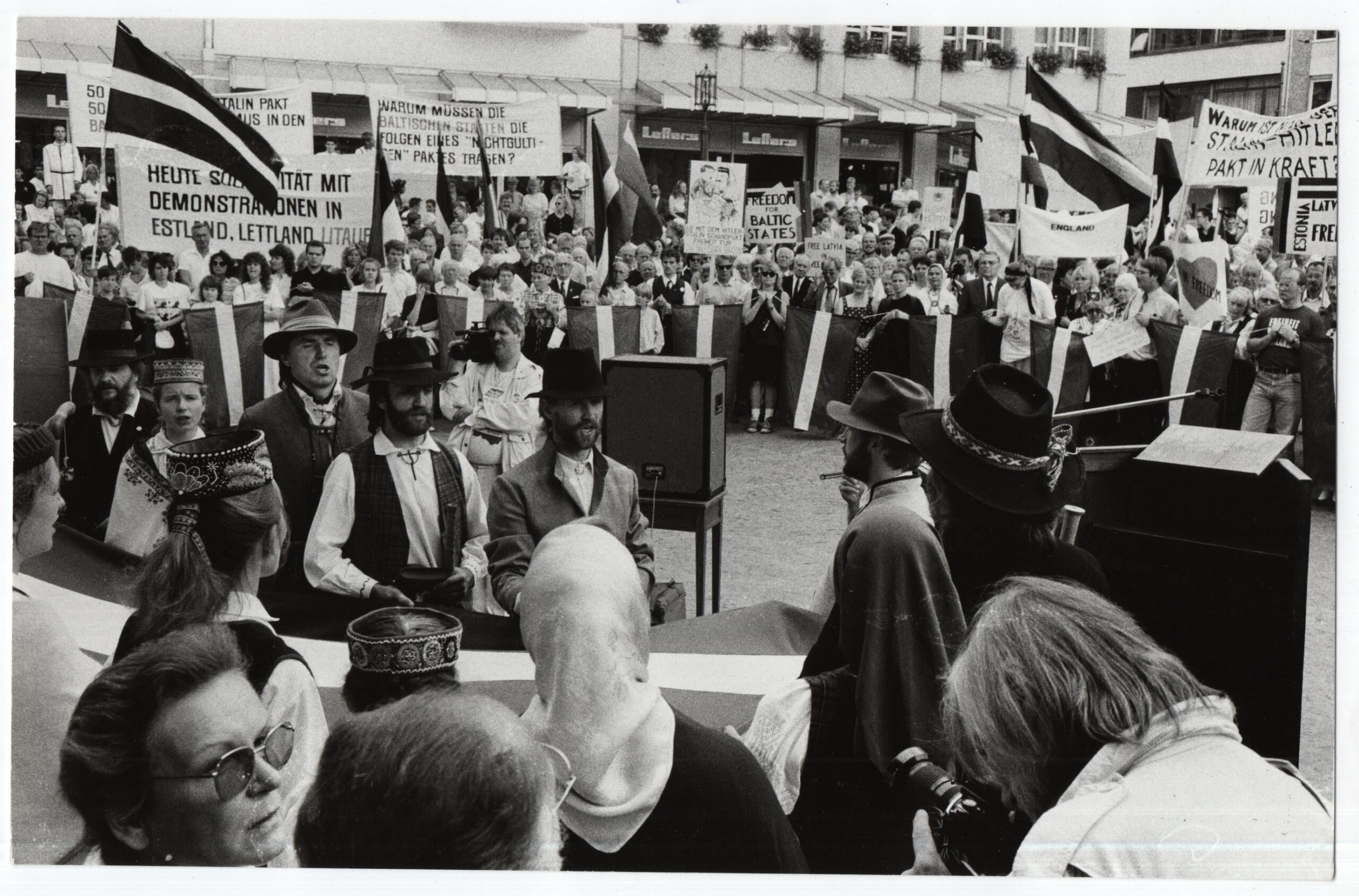
Figure 6. Folklore groups Skandinieki and Grodi participating in the Baltic Days in Bonn, Germany, August 23, 1989 – a demonstration against the Molotov-Ribbentrop Pact. Photo by Uldis Grasis. Latvian State Archive, LNA_LVA F2191_1v_5_12.
From Folk Culture to Political Movement
For Latvia’s folk revival movement, the appearance of the banned flag at Baltica ’88 marked a turning point. What had once been primarily a cultural activity centered around collecting folk songs, performing traditional music, and celebrating heritage now became an explicit form of political engagement. In the years that followed, folk groups joined mass demonstrations and the barricades that defended Latvian independence in January 1991. Their songs, costumes, and symbols became part of a broader movement demanding freedom. As for the banned flag, the events moved quickly after the summer of 1988. On September 29, the Latvian Soviet authorities officially relegalized the carmine-white-carmine flag as a “culturally historical symbol”. Soon, it appeared widely at public gatherings and celebrations. By 1990, it had become the official flag of the Latvian Soviet Socialist Republic, and after full independence in 1991, it was restored as the national flag of the Republic of Latvia. The carmine-white-carmine flag thus tells a larger story: It shows how small symbolic acts like singing a song, wearing a ribbon, and raising a flag can gradually evolve into powerful political resistance. In Latvia, those symbols helped transform cultural identity into a movement that ultimately reshaped history.
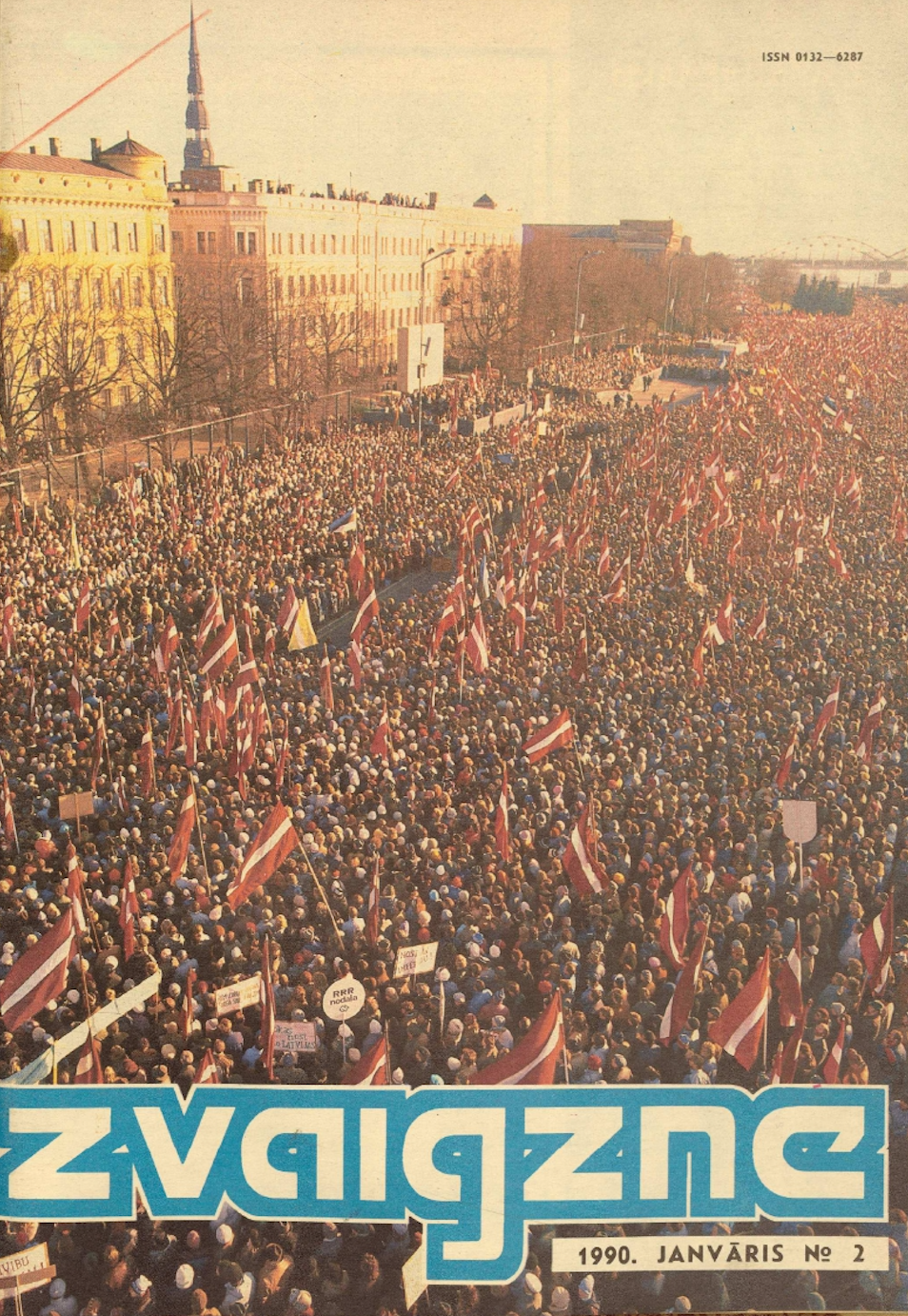
Figure 7. Cover page of the magazine Zvaigzne for the January 1990 issue, depicting the events of November 18, 1989, when the Latvian Popular Front organized a demonstration “For an Independent Latvia”, which gathered around 50,000 participants. For the first time since World War II, official events were held to mark the proclamation of the state on November 18, 1918.
Audiovisual sources
Online exhibition The Folklore Movement in Latvia. Available at: https://lfk.lv/the-folklore-movement-in-latvia/
Baltica ’88 opening concert. Archive of the Estonian Public Broadcasting, https://arhiiv.err.ee/video/vaata/baltica-88-avakontsert-1-osa
Alfrēds Stinkuls Collection, LFK 2264. Archives of Latvian Folklore, https://garamantas.lv/en/collection/1753523/Alfreda-Stinkula-kolekcija
Further reading
Beissinger, Mark R. Nationalist Mobilization and the Collapse of the Soviet State. Cambridge University Press, 2002.
Bergmane, Una. Politics of Uncertainty: The United States, the Baltic Question, and the Collapse of the Soviet Union. Oxford: Oxford University Press, 2023.
Bertran, Aleida. “Theorizing Festival Programmes as Manifestos: The International Folklore Festival Baltica during the Singing Revolution (1987–1991)”. Letonica, No. 57 (2025): 102–124. https://doi.org/10.35539/LTNC.2025.0057.05
Karklins, Rasma. Ethnopolitics and Transition to Democracy: The Collapse of the USSR and Latvia. Baltimore: The Johns Hopkins Press, 1994.
Lindqvist, Mats. “Giving Voice to the Nation: The Folkloristic Movement and the Restoration of Latvian Identity”, 185–243. Lindqvist, Mats (ed.). Re-inventing the Nation: Multidisciplinary Perspectives on the Construction of Latvian National Identity. Botkyrka: Multicultural Centre, 2003.
Muktupāvels, Valdis. “The “Dangerous” Folksongs: The Neo-folklore Movement of Occupied Latvia in the 1980s”, 73–90. Peddie, Ian (ed.). Popular Music and Human Rights. Vol. II: World Music. Farnham & Burlington, Ashgate, 2011.
Pumpuriņš, Tālis. Latvijas valsts karogs [Latvian national flag]. Nacionālā enciklopēdija. Available: https://enciklopedija.lv/skirklis/8867-Latvijas-valsts-karogs, 2025.
Stavělová, Daniela; Buckland, Theresa Jill. Folklore Revival Movements in Europe post 1950: Shifting Contexts and Perspectives. Prague: Institute of Ethnology of the Czech Academy of Sciences, 2018.
Škapars, Jānis (ed.). The Baltic Way to Freedom: Non-Violent Struggle of the Baltic States in a Global Context. Rīga: Zelta grauds, 2005.
Šmidchens, Guntis. The Power of Song. Nonviolent National Culture in the Baltic Singing Revolution. Seattle, London: University of Washington Press, 2014.
Ūdre-Lielbārde, Digne (2025). “Visualizing Cultural Opposition: Folklore Movement in Late Soviet Latvia”. Letonica 57 (2025): 68–100, special Issue “Folklore Revivals in Non-Democratic Contexts”. https://doi.org/10.35539/LTNC.2025.0057.04
More on the Topic
“The world really needs her.” A conversation about Tove Jansson’s Art with Sirke Happonen
Sirke Happonen is a Tove Jansson researcher and a senior lecturer for Childrens’ Literature in the Faculty of Education at the University of Helsinki. We met her at the workshop “Tove Janssons Mumins: Resilienz erzählen/resilient erzählen,” which took place during the 2025 “Nordischer Klang” festival in Greifswald.
Der demografische Wandel als potenzieller Wendepunkt für Demokratien?
Demografie und Macht waren schon immer eng miteinander verbunden. Historisch betrachtet, betrifft dies vor allem die Bevölkerungsgröße und die Frage nach dem militärischen Mobilisierungspotenzial. Heute sind aufgrund von steigender Lebenserwartung und niedrigen Geburtenraten insbesondere sich verändernde Altersstrukturen von Interesse, beispielsweise mit Blick auf die wirtschaftliche Leistungsfähigkeit und die Tragfähigkeit der Sozialsysteme.