
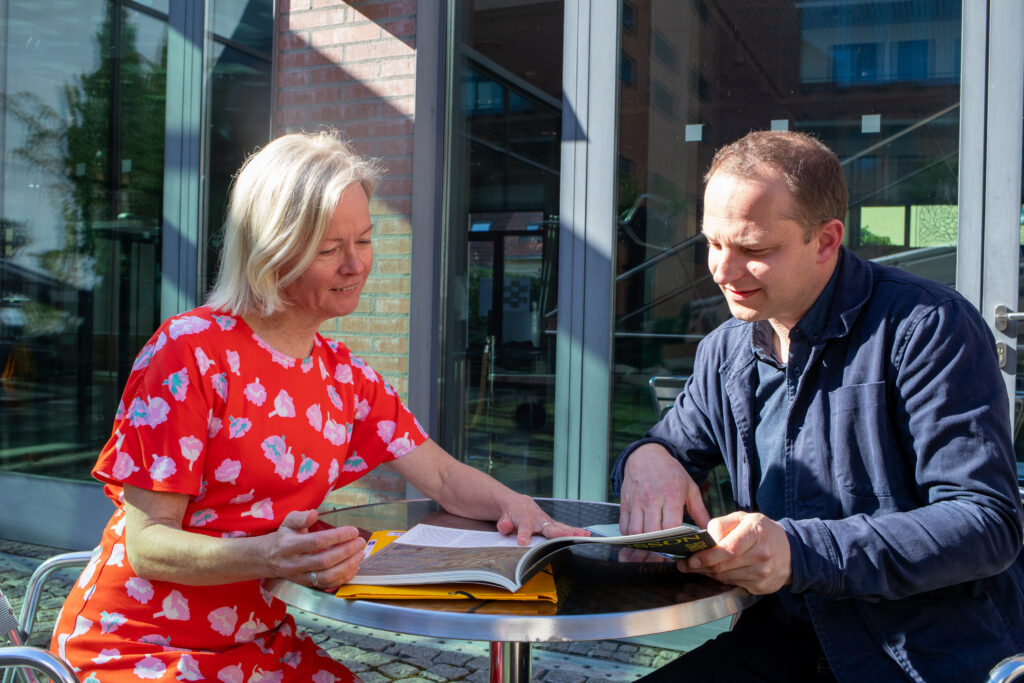
Sirke Happonen is a Tove Jansson researcher and a senior lecturer for Childrens’ Literature in the Faculty of Education at the University of Helsinki. We met her at the workshop “Tove Janssons Mumins: Resilienz erzählen/resilient erzählen,” which took place during the 2025 “Nordischer Klang” festival in Greifswald. The interview was conducted by Alexander Waszynski. Photo: Marie-Luis Quinn Westfeld.
Enter Moomins
I would like to start with a question about your research biography: One of your first academic publications in the early 2000s was about movement in Tove Jansson’s picture books for children. In your doctoral dissertation, you explored movement on various levels, from language to posture and change in narrative. How did this research focus—and the Finnish-Swedish author and artist Tove Jansson—enter your life? Did you, at the time, expect it to occupy you for more than two decades?
I’ve done various things with Tove Jansson and the Moomins. But movement—and dance—is something that I’m returning to now. Ever since I did my thesis on Jansson, I wanted to study her way of combining words and images, because I thought that was the unique and wonderful thing about the Moomin books that actually gives them so much depth and a happy surface as well. My doctoral thesis was about that, and then I wanted to add the element of dance, because it is related to both illustration and text.
I wrote to Tove Jansson at one point. I told her about my ideas—besides dance I considered examining solitude, amongst other themes—, but she was confident in her advice: “Write about that! Nobody has written about dance so far.” She also described what dance had meant to her. So I had dance as a third element in my thesis.
My idea was to build a theoretical framework and find ways to analyse both illustration and text. Often it’s either this or that, and it was difficult of course to make it work, but I think I was able create tools that still work when looking at her work today. Her writing is full of images; it’s very pictorial, sometimes even ekphrastic. Jansson was even criticised for being too narrative and for including too many stories in her images, a criticism that must be understood against the backdrop of the new era of abstract art.
I’ve been involved with many interesting projects, including theater, ballet, and exhibitions. In 2025, I have had the chance to work with three exhibitions on Tove Jansson, including two in Finland, in Helsinki and Kotka, and one in Tallinn, Estonia. In the first one of these, the exhibition “Paradise” at HAM Helsinki Art Museum about her murals and her public paintings, my contribution is an analysis of her murals and identifying links with the Moomin world. Thinking back to some previous projects, I recall a choreographer who was creating a Moomin ballet, who called me asking “How do the Hattifatteners move? How could I do this? What do you think? Would it be like that?” . It’s an illusion of movement. When I had finished writing my thesis, a contemporary dance group started working on a performance based on the Tales from Moominvalley (1962) and inspired by my thesis. I have also worked with stage designers and composers on Moomin performances.
Currently, I’m translating a corpus of Tove Jansson’s songs, including her love songs, into Finnish. I’ve also translated a collection of short stories and essays and her debut picture book.
I didn’t know all this would happen, because Tove Jansson wasn’t so big, when I started my doctoral thesis. When presenting my research ideas for the first time, I was told that since there already is a comprehensive doctoral thesis on Jansson’s Moomin literature (referring to Boel Westin’s Familjen i dalen: Tove Janssons muminvärld, 1988), it is kind of done. You should work on something else. There’s nothing more to write about her. But I could sense that Jansson is really remarkable. You could start an institute. Now the world has discovered Tove Jansson as well, and it seems like the world really needs her. This is perhaps only the beginning.
Text, images, translations
You mentioned that it’s not easy to address the double dynamic in Jansson’s books, as the images are not illustrations in a strict sense, but have their own life, as does the text. What are then your key tools and methods for grasping this dynamic?
I was inspired by the idea of researching picture books that might be considered ‘equal’ in the sense that both images and words are examined in depth. If you read Jansson’s books—not only her picture books, but also her illustrated novels—you perceive and process both images and words pretty much at the same time. So I’m trying to combine concepts such as framing and movement from visual art with narratology, and to examine verbal and visual aspects in relation to perspective, colour and composition . It’s difficult to explain what I do, but when I published my thesis, I was told that I had somehow managed to actually show how Jansson is combining things.
What would you consider to be the biggest challenge in the process of translating Janssons works from Swedish? Is it a question of audience? Are there perhaps parts of the text that are untranslatable?
From what I can see, no — though it does depend on the language you’re translating into. First, Jansson does not address adults differently from children. She speaks with the same tone of seriousness to both of them, to everybody. For her characters, age is not a huge issue either; age and gender are not as important as individuality. Who cares about gender and age? I mean, yes, we care, but you can be whoever you want to be. That’s the most interesting thing.
Although Jansson writes her works in Swedish, some of this openness and freedom seems even more ingrained when expressed in the Finnish language, since we don’t even have the pronouns “he” and “she” but one word, “hän”. Many Finnish speakers have not even thought about characters like the Groke (Mörko/Mårran) being male or female. In the original books, Groke is a “she”. However, in the earlier animations, the character is typically voiced by men.
My biggest challenge at the moment is translating Jansson’s songs. I cannot always fit everything that Tove Jansson wrote in Swedish into the Finnish translation. I have to make choices. It’s quite horrible. This is because we don’t have many verbs—or words in general—with only one syllable in Finnish. In Swedish, there are so many more. I also have to make sure my translations fit the music, and that they’re singable. I quite enjoy this work, though!
Disasters and “destruktionsglädje”
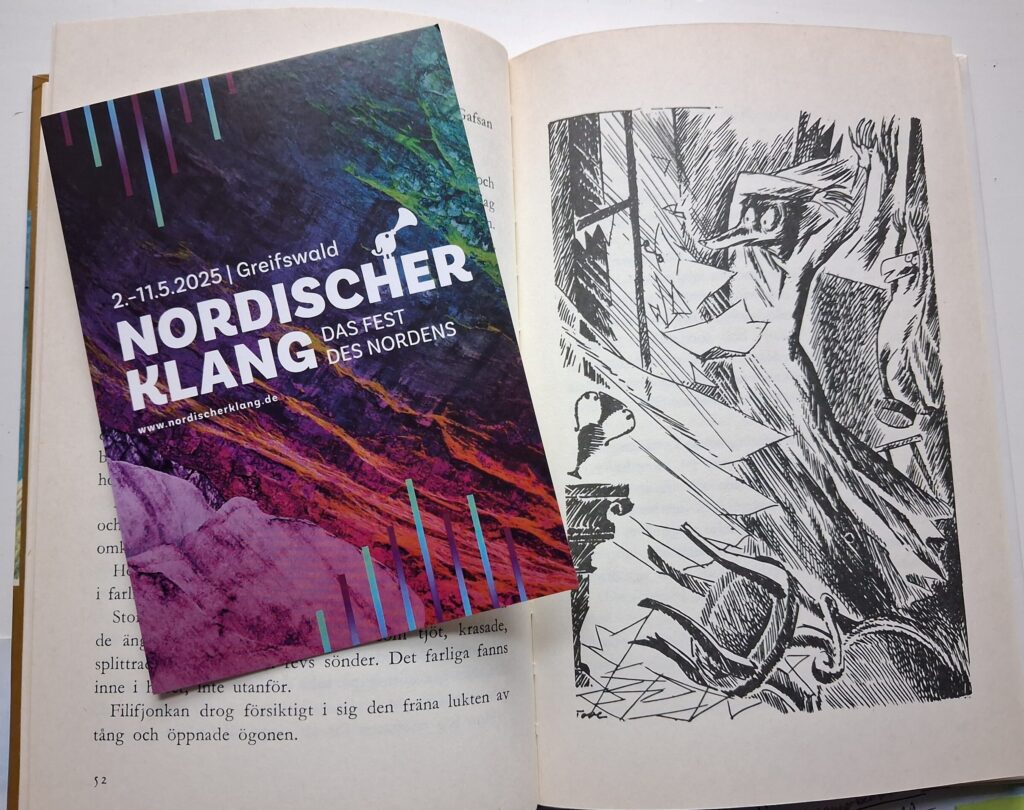
In one of your earlier essays, you examined the short story “The Fillyjonk Who Believed in Disasters” from the collection Tales of the Moominvalley (1962), about a very anxious fillyjonk—one of the many species/characters populating the valley—who sees her fear of natural disasters coming true. When the Fillyjonk encounters the tornado, she thinks, “Oh, my beautiful, wonderful disaster.” After it has destroyed her home and taken her belongings, she reflects enthusiastically, “Now I’m free; now I can do anything.” For her, catastrophe is a liberating force. If we read the Tales just as Fillyjonk reads the world, we might assume that catastrophic events depicted in the story could have a similar effect on the reader: “I’m still reading; I’ve done it; I’m free; I got through the catastrophe”. Do the Moomins, who deal with a whole series of catastrophes—like the comet (Comet in Moominland, 1946), the flood (The Moomins and the Great Flood, 1945), the winter, way too much winter (Moominland Midwinter, 1957)—suggest a more liberating mode of reception and reading?
There’s always the possibility of reading metaphorically, or just thinking about natural catastrophes, which is exciting and something you might never experience. Isn’t it interesting to think about what would happen? In one of her essays Tove Jansson writes about “destruktionsglädje” (joy of destruction), about how a child’s sense of “destruktionsglädje” can be positive. You can imagine a huge wave, for example. She didn’t write about this in relation to war or our climate crisis, but rather to a very big rain or snowstorm where you can’t open the door anymore. You’d have to stay inside for a week. How exciting that would be! But it’s more like fantasy, a mere idea.
Jansson was interested in phenomena like great storms and ships on the waves, as well as comets. She probably experienced the threat of nuclear war as well. It is, of course, possible to read Jansson’s works in the context of man-made disasters. But I think it would be wrong to think only of war in relation to the first Moomin books.
Coming back to Fillyjonk and to the image of her leaning towards the storm: At first, the text is full of expressions like she runs into her pantry and hides, “she rolled herself into her quilt”, saying things like “I know everything will turn out badly”. But when the catastrophe comes, there’s this sudden liberation and a combination of two movements, of contraction and release. Jansson teaches us to also see the liberating side of things. If you manage to get through a snowstorm, for example, that’s a small catastrophe you’re experiencing, like Moomintroll in Moominland Midwinter (1957) when he’s really up against a snowstorm, but suddenly he realises he can turn around and just fly with it.
Dance as an interruptive force
You discussed the different roles that choreographed scenes play in Tove Jansson’s work, referencing the history of modern dance from Rudolf von Laban to Martha Graham. To some extent, the Moomin dance scenes serve a similar purpose to disasters in that they disrupt the progression of events simply by occurring unexpectedly. Could you perhaps say something about the ‘interactive’ force of dance and narration in relation to the ‘interactive’ force of nature depicted in Jansson’s books?
I think it is really like that. But dance as a force, as something that is actually happening, is difficult to put into words. It can change the direction of something, providing a sense of liberation and changing the mood.
In Jansson’s autobiographical short story “The Bays” (“Havsvikarna”, in Bildhuggarens dotter, 1968), she describes how, as a child, she used to walk from bay to bay in Pellinki, an archipelago not very far from Helsinki, at 4 o’clock in the morning. She goes to a bay full of reeds and touches them. They move and make all these sounds, and she becomes one of them. I think that’s beautiful. But I don’t know if you could compare that to a disaster that changes things. It’s a significant event to experience that kind of dance, a dance of nature, where you literally immerse yourself in nature and dance with it.
Dancing outside, and even detached from music, marks an important threshold in the history of modern dance (and has its fallacies as well), for example with Rudolf von Laban’s and Mary Wigman’s famous dance studies on the beach of the Lago Maggiore in the 1910s. I was curious about your mention of a certain change over time in Tove Jansson’s work in your lecture today. In the 1960s she tended to include in her books more improvisation in dance and less formalized styles like tango, samba, or else. Is there a correlation whereby the plot also changes towards a more diverse structure? You said that some critics felt there were too many narratives.
Two things are happening at the same time already in Jansson’s Moomin books. We can consider how the characters fit into the landscape. In the early books, they look at the landscape. It is kind of framed. Landscape is described as something you gaze at or admire or are impressed by, or a setting for an adventure.
From around Moominland Midwinter (1957) onwards, the landscape and the movement of landscapes starts to go through the characters. They become something else. The Moomintroll needs to go low as the heather is growing, suddenly, a tree starts moving, the sand is escaping. One could refer to Shakespeare’s Macbeth or the cinema of Akira Kurosawa. It’s like the whole island is full of contractions and releases.
At the same time, in her writing and art, Jansson cuts out the details, avoiding too many adjectives and too many words in general, as well as too many colours. She makes everything more plain. In her visual art, there’s increasingly room for abstraction, although she only started creating non-figurative art in the late 1960s. All these things are connected. In almost every book, she challenged herself by using different techniques.
Murals and underwater paintings
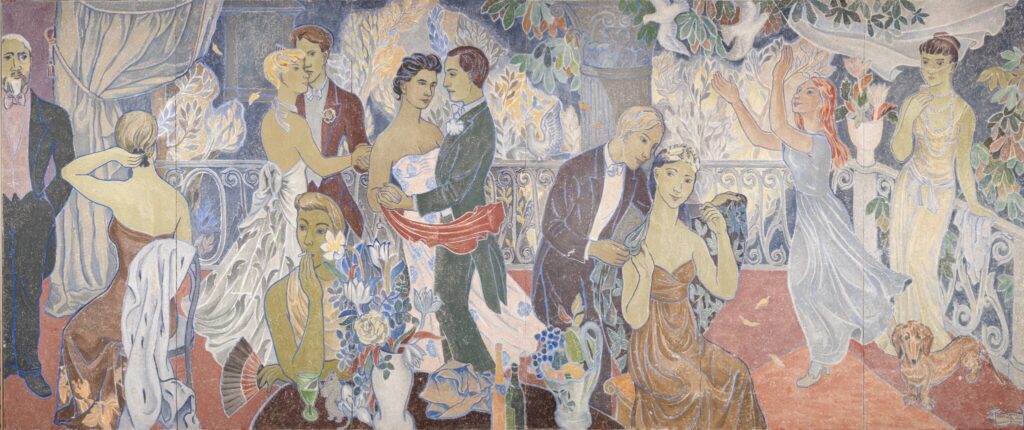
When you introduced the mural Party in the City (1947) in your presentation, I had to laugh a little bit: If there is one thing that does not move and that is steady as something can be, it is a wall. Painting a dance scene onto a wall is quite a coup, I think. The materiality directly opposes the representation. Maybe you can let us know something about this tension between materiality and imagery in Jansson’s work. Also: Not everyone is dancing in this scene, right?
Yes, it’s her former lover, Vivica Bandler, a main protagonist of the Finnish avantgarde theatre in the 20th century, who’s dancing in the middleground. Jansson herself sits at a table in the foreground facing the viewer of the painting. In a song of hers, Jansson also writes about her dance and the colors, in particular about the ‘heaviest’ color, an intense carmine red. She adds this color to the painting because the relationship is coming to an end.
I think that’s a fascinating thought about making a wall dance. Many of her murals and public paintings depict dance, or movement at least.
She had also an enormous amount of flowers in those paintings, in general a lot of decorative elements. Even her underwater mural A story from the bottom of the sea (1952), painted for the city of Hamina, bursts with coloristic flora and fauna.
There were certain things that she had to include. She said that when she was creating these public paintings, she wanted to relax people, bring them joy, encourage them to interact with each other, and allow them to interpret the images in their own way. There are often narrative and funny elements. She loved all these small characters, for instance birds and dogs, or the Moomintroll, which appears in many of her paintings. And when you discover them, suddenly, they may be staring at you.
Global resonances
Outside of Scandinavia and Finland, in Poland and in the Baltic States, Tove Jansson is particularily well known as an author and painter; in Germany, some people are familiar with her work and some are not. Could you perhaps tell us a little more about this global reception history and the differing levels of popularity?
I don’t really know why this is the case. It seems to me that in countries like Poland the reception has been steady. This big interest in Tove Jansson has been there all the time, also in Lithuania, for instance. I’ve been giving papers in these countries and it seems like people really know Jansson’s art. Different age groups know her stories and know her.
In Japan, she’s been very beloved. When one of my books was translated to Japanese, I spoke to my translator and once asked “What do they think about the Moomins really?” She said that people in Japan know the Moomins, the characters and the shapes very well, but not so much the stories. Still, the absence of any dichotomies is understood very well. There is no good vs. bad. In Japanese literature, in folklore, and also in comic strips, take Naruto, for instance, dichotomies are often also undermined. It’s not like the characters can’t be or aren’t bad, but they can also have a good side. That was given to me as an answer.
It was a great surprise to me, when Sommarboken (1972) was republished in Britain in the early 2000s. There had been an interest in Jansson’s books and comics before, but then Summer Book suddenly started something in the English-speaking world that is still growing.
Another rumpus
Recently, I gave a seminar together with a colleague on the American illustrator Maurice Sendak: His work might make a great point of comparison. Many of the topics we discussed today are relevant to his work, too, including dance. In Where the Wild Things Are (1963), for example, there is the big rumpus dance. Has any work been done on this comparison?
Absolutely, I do refer to Maurice Sendak in my thesis. He also wrote about the relationship of literature with music in Caldecott & Co (1989). I found parallels with Jansson’s approach to dance. He wrote that music gives a rhythm to images; he used works like ‘quicken’ and ‘vivify’, which are applicable to Jansson as well. His book gave me confidence to write about this topic, too.
Thank you so much for this conversation!
The interview has been edited and shortened. Editing: Luise Markwort. Revision: 26 May 2026.
Literature
Happonen, Sirke. “The Dancing Moominvalley: A Choreographic View on Tove Jansson’s Illustrations and Texts,” Nordiques 35 (2018), https://doi.org/10.4000/nordiques.836
Happonen, Sirke. Vilijonkka ikkunassa. Tove Janssonin muumiteosten kuva, sana ja liike, Helsinki: WSOY, 2007.
Harni, Heli and Tuija Huovinen (eds.) Tove Jansson: Paratiisi – Paradiset – Paradise. HAM Helsinki Art Museum publications. Helsinki: Förlaget M, 2024.
Jansson, Tove. Småtrollen och den stora översvämningen [The Moomins and the Great Flood]. Helsinki: Schildts, 1945.
Jansson, Tove. Kometjakten [Comet in Moominland]. Helsinki: Schildts, 1946.
Jansson, Tove. Trollvinter [Moominland Midwinter]. Helsinki: Schildts, 1957.
Jansson, Tove. “Den lömska barnboksförfattaren” [1961], in Bulevarden och andra texter. Helsinki: Förlaget, 2017.
Jansson, Tove. Det osynliga barnet och andra berättelser [Tales from Moominvalley]. Helsinki: Schildts, 1962.
Jansson, Tove. Bildhuggarens dotter [Sculptor’s Daughter]. Helsinki: Schildts, 1968.
Jansson, Tove. Sommarboken [The Summer Book]. Helsinki: Schildts, 1972.
Klingenberg, Emma. Detta är min målarsång. Tove Jansson och musiken. Helsinki: Förlaget, 2025.
Sendak, Maurice. Where the Wild Things Are. New York: Harper & Row, 1963.
Sendak, Maurice. Caldecott and Co: Notes on Books and Pictures. New York: Michael di Capua Books / Farrar, Straus & Giroux, 1988.
Westin, Boel. Familjen i dalen: Tove Janssons muminvärld, Stockholm University 1988.
More on the Topic
Der demografische Wandel als potenzieller Wendepunkt für Demokratien?
Demografie und Macht waren schon immer eng miteinander verbunden. Historisch betrachtet, betrifft dies vor allem die Bevölkerungsgröße und die Frage nach dem militärischen Mobilisierungspotenzial. Heute sind aufgrund von steigender Lebenserwartung und niedrigen Geburtenraten insbesondere sich verändernde Altersstrukturen von Interesse, beispielsweise mit Blick auf die wirtschaftliche Leistungsfähigkeit und die Tragfähigkeit der Sozialsysteme.
When a Flag Became a Protest: Latvia’s Carmine Red and White Colours, Folk Revival Movement and the Singing Revolution
The Baltic States’ regaining independence from Soviet occupation was remarkable for its largely non-violent character. Enabled by the political reforms of perestroika...